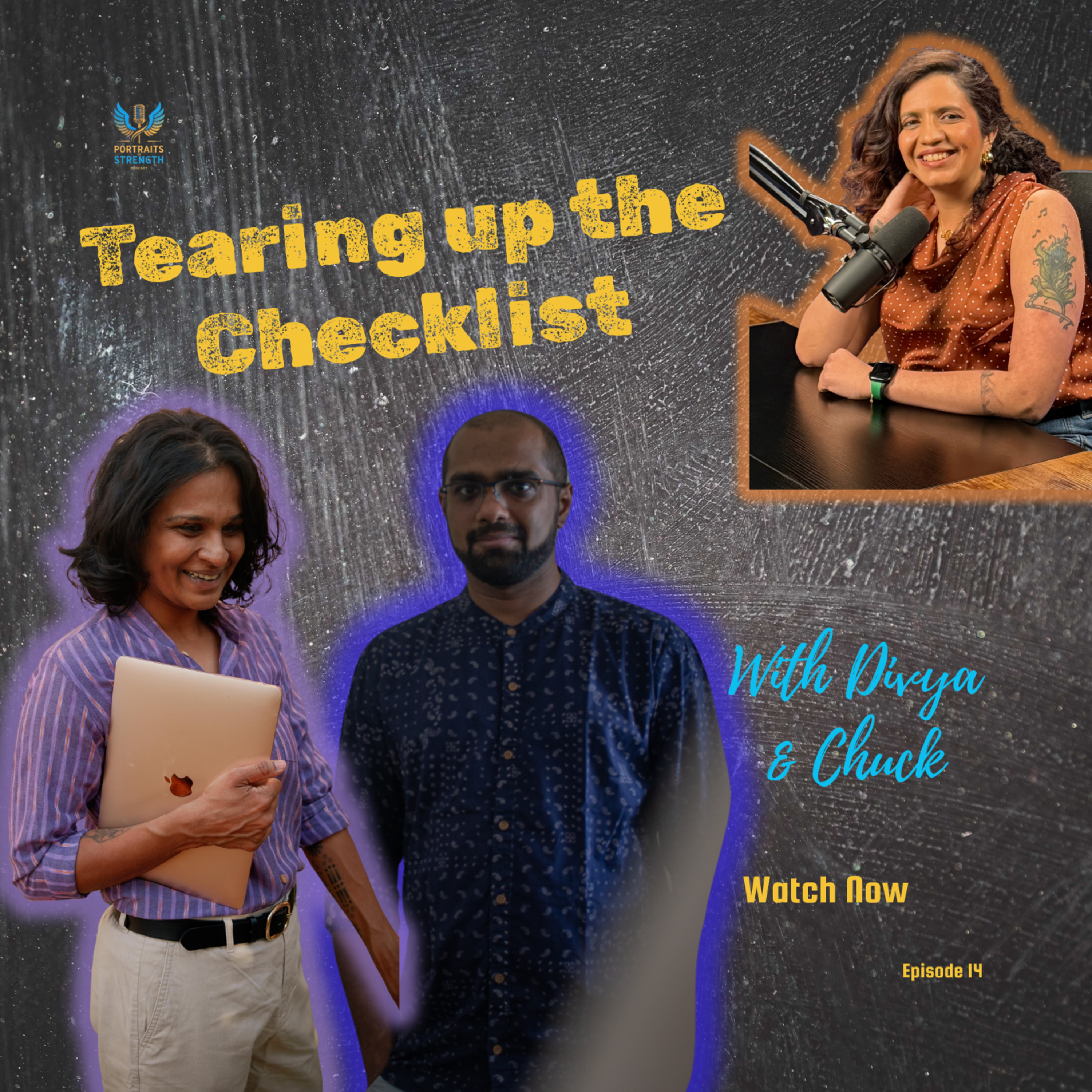
Tearing up the Checklist with Divya & Chuck
The Story
Divya and Chuck are a husband-and-wife duo who run their own strategy and content business, and somewhere along the way they stopped following the script everyone handed them. Divya walked away from a law career to work at a tiny ad agency run out of an actual garage. Chuck, an engineer who never knew other options existed, found his calling through a random advertising magazine that landed in his lap. In this conversation, they trace their paths from a bookish latchkey kid in Bombay and a studious boy growing up in Bahrain’s heat to two people who built a business, a marriage, and a child-free life on their own terms.
We talk about the millennial checklist, the art of sneaky rebellion, how to work with your spouse without losing your mind, and why strength might be less about the big leap and more about what you can sustain. Growing up in Bahrain and in Pune and Bombay, and why both of them call their childhoods “unremarkable” in the best way
Chuck’s move from the Gulf to Cochin, the culture shock, and drawing comics to find an identity, Divya’s leap from law to advertising at a fraction of the pay, and the parents who were horrified by the garage office.
Chuck’s theory of “societally acceptable rebellion” and finding a path his family could live with, going freelance in a week, the one metric he set for his first year, and Divya joining him before incorporating.
Working with your spouse: the WhatsApp vs. Slack rule that kept work and life from colliding, choosing a child-free life, and how both families came around (one cat grandson later). Chuck’s brutal 2009 and the comeback year that followed, without leaning on escape hatches, Divya on fear, self-doubt, and the people who believe in you before you do. Solo trips, separate hobbies, and why time apart makes time together richer.
Advice for anyone in their 30s or 40s feeling the weight of the checklist.
Their definitions of strength: staying in the game, and knowing the story you’re telling yourself
A Moment That Will Stay With You Chuck compares strength to lifting weights. You can chase the heaviest lift once and risk the injury, or find the weight you can lift every single day and build from there. For him, strength isn’t your maximum. It’s the minimum you know you can sustain. It’s a quiet reminder that the people who last aren’t always the ones who sprint.
Connect with Divya & Chuck. Rough Paper Creative
Listen & SubscribeAvailable on Spotify, Apple Podcasts, and YouTube. If this episode made you rethink your own checklist, share it with someone who needs the permission slip, and leave us a review. It genuinely helps more stories like this one reach the people who need them.
I don't need to follow the checklist, let me just make my.
Giving yourself the conviction that, oh, I can also do something like this and there's a example that I can possibly learn from. You make your own luck, yes, but luck also has a role to play. I would like, let's not talk about work on WhatsApp. Yeah, we got a Slack account and we're like, we'll talk about work on Slack, we'll talk about life on WhatsApp. And I think that small thing itself just simplified things. Hi friends, and welcome back to another episode of Portraits of Strength. I am your host, Harry the Anecdotist.
Today I'm sitting down with two guests at once, Deepak, who everyone calls Chuck and Divya, their life partners, business partners, and the team behind Rough Paper Creative, a brand strategy studio they build from scratch. If you grew up like I did, you are handed a checklist. Study engineering or medicine, get the job, get married, have a kid, have another kid. Nobody asked if you wanted any of it. You just take the boxes. Chuck and Divya looked at the same checklist and they will chucked it, and the life they built instead is full in every direction.
Work they love, hobbies they chase, and a marriage where each of them cheers the other on. And that's exactly what I wanted to dig in. How do you walk away? From the script that everyone expects you to follow and still end up with life this rich. This is portraits of. Strength. Thank you so much, Divya and Chuck for being on Portraits of Strength. So let's start off with, let's start off with, let's start with what kind of kids you were and what your what your childhood was like. Were you naughty, quiet, driven?
You know, I want to know all about that. Harry, starting with the easy questions. I see. I'll start. I guess I grew up in the Gulf, a tiny country called Bahrain, which is between Qatar and little above Saudi Arabia. I was born there and spent till my 10th standard pretty much over there. So whatever age that was, 1516, it was, I'm going to say it was a fairly boring childhood kind of because getting around was difficult and always dependent on parents to drop you to your friends place and all that.
So we never really hung out on a daily basis or a weekly basis. So once school was done, parents ferry you back home and that's pretty much where you spent the rest of spent the rest of the day and social settings, meeting other friends, etcetera. Was usually under adult supervision, right? So happens in home and all that. Also Gulf is damn was damn hot at that point of time. Still is hotter, I suppose. So going outside and playing etcetera wasn't really part of life growing up. Growing up there, we also didn't have that much programming on TV for a very limited period of time.
They were actually cartoons or whatever it was that appealed. To you know us of various age groups. Till there I had access to cable only when I was in 9th standard and in retrospect I think that was a good thing. As a result of which, by design or by circumstance, I was fairly studious. I, I suppose I, I suppose you could say I was a good kid, like academic. Or whatever the case was. I used to read a lot. That was my solace. I used to devour anything I could get my hands on, whether it was, you know, the usual comics like a Tinkle or Archie.
We had a few magazines in the Gulf growing up, like, just like you have, you know, the youth supplements of newspapers. That's a big, big thing in the Gulf. Yeah. So we had a few of those. Going Up Readers Digest, Kids I. Think yeah, yeah, Readers Digest kids. Yes, yes, yeah, yeah. So we had a paper called College Times, which had a supplement called Young Times. And a lot, if anyone from you know, if there's anyone who's listening, who's grown, grown up in the Gulf, especially millennials, they'll hard relate.
And a lot of wave of nostalgia will come back when I hear I say Young Times, but that was what childhood was like really. I would call it largely unremarkable. And I don't mind it being unremarkable. Actually, I think it was. It just laid the foundation for a lot that was to come. I do remember specific things that happened, I suppose, like few friends that I had or few, but I wouldn't say there were that many quote UN quote formative memories that happened during childhood. I think it was more 16 years of slow burn that kind of, you know, it's not a, what do you say?
It's not a it's not insignificant. It's not like if you removed that part, everything else would remain the same. But yeah, it was, it was a nice, it was a nice sweet childhood. We were a close family growing up. Not very close, but still like, you know, close enough. Sure. Yeah. That is, that is what life was like growing up, at least. Growing up Divya. You, well, I, when I was a kid, I lived in Pune and Bombay and I was a really quiet kid. I think I was only child also. And I was like very quiet and very Padaku kid because I think that's what was expected of me.
And I used to read a lot. And I actually think that I had a very sheltered childhood also. And I think I ended up being quite a boring child, to be very honest. And, and like, even when I moved to Bombay, I think I was, I was like quite out of place in school. I was need a little bit. And you know, and kids are kids can be damn cruel. Oh yeah, definitely. Even now I can see that with my daughter I'm. Really scared of teenage girls. Can I say even now? Oh yes, I can. I can vouch for that. But yeah, like I used to read a lot and I used to, I used to watch a lot of TV because I was also like latchkey kid because I used to come home at 3 or whatever after school and then spent 4 hours with the TV until my parents came home from work.
So I knew what day of the week it was by what TV show is on that day or what. It's a lot of shit that I shouldn't have been watching at that age because cable TV. He just got experimentative and just put all sorts of strange reruns. And man, OK. And I should not have been watching that at that. But and I started writing just on my own at 1415. I started blogging and like putting my thoughts down on everyone had a blog back then called. Like, yeah, yeah. Or thoughts of a troubled mind or whatever.
Yeah, yeah. I had a blogspot I started and I used to spend a lot of time blogging, spent a lot of time online. More than talking to like people. I was just like, and I feel that when I went to college is when I kind of developed a personality once I got some space and distance from home. And I actually think that can be so valuable for kids. Yeah. To get some space, get some time to figure out who you are and what you like and stuff. Yeah, Yeah, I relate to that. I kind of relate to that. I know you didn't ask about college necessarily, but just continuing from what Divya said, I think so I spent till 10th in the Gulf and it was kind of like that.
And towards the end of it, there was some formative aspects of what would you know, my personality or interest later would come up right. Like I started getting interested in music around again. Unsurprisingly, when cable TV came into my life, I started writing a little bit drawing and I always used to be a good, I used to draw very well. I always used to, you know, get whatever it is like art used to be something that I used to be good at. But then I started actually like getting inspired by some of the cartoon, the the books that I was Archie or whatever.
I first started replicating those and then I just started, you know, making my own comics and all that sort of thing. And usually these comics were just silly little in jokes between my class and all that. When I went to 11th and 12th in Cochin, I think it opened up my mind so much in terms of wow, people around me are just doing so much. Also, you moved after 10th from. Yeah, yeah, yeah, yeah. Gulf to Cochin. Was that a culture shock for you or? Yes, it was it, it, it very much was it, it very, very much was in terms of academics, not so much because you're going from CBSE 10 to CBSE 11.
So in terms of academics, not so much there was continuity there, but in terms of the people around me, the things that they were doing. Also in terms of the people around me, in terms of the sheer amount of things that they were doing right. Like in the Gulf, I remember they were you had your guy, you had your kids who are good at studies and then you had your kids who are good at sports and then you had your kids who are good at, say, art and stuff like that. Here you had somebody who had, yeah, segregate.
No, segregate. I mean, not segregated by the school or something is just a different yeah, yeah, yeah, yeah. But when I came over here, it is like the same person was scoring 95% in math and was part of the cricket team and could draw well and could sing. Like, it just absolutely blew my mind in terms of, you know, the sheer amount of things that people were doing together. The second thing was the people who were quote, UN quote, not so good at studies, I found out that these guys were also good at so many other things and maybe skill set I wouldn't be very good at necessarily, you know, like running around at organizing things and all that sort of thing.
I mean, it was a lot of culture shock it had, it gave me a lot of impostor syndrome. But the other thing also was my second language, Malayalam wasn't all that great. So it I struggled to fit in a little bit from that point of view. Also, I'd like to actually think in many ways, and I'm also saying this, Harry, since you're an alumnus, alumna of the 6% Club, which is the content creation program. Except I'd like to think that my first quote, UN quote content project actually started in college when in a desperate bid to find an identity for myself, I started drawing comics based on, you know, the personalities around me.
Yeah, the personalities around me, the teachers and all that sort of thing. And that was kind of cool for a while. Like, that was my thing. That was what I would do, you know, and but it was also like Divya said when I went to college, really, that a lot of identity really formed in terms of the music that I like, in terms of the people that I want to hang out with and some sense of what I want. Life, sorry, career, if not life to look like it's it's way to, I mean, 20. It's pretentious to think that I knew what I wanted life to be like as an 18 year old or something.
But yeah, I think that's what is. What is interesting for me is that you know, like I had my education like growing up, schooling as well as engineering in Andhra Pradesh, you know, Hyderabad and Vishakhapatnam. And I don't know how much you know, but in Andhra, the Telugu people, the only careers are either you're a doctor or you're an engineer. That's it. And growing up, I know it's changing quite a lot nowadays, but growing up, you know, we are all fellow millennials. So I think we're all in the same boat here.
But growing up for me was like, OK, all the hobbies are good. Well, and good till you're in 8th or 9th grade. From 10th grade, you have to get serious. Yeah. No more hobbies. No more other, you know, activities that can distract you. It's only studies. So no matter how good I was at organizing or dancing or other stuff, it all got cut down to the bare minimum. So it's kind of interesting for me to learn that that wasn't the case for, you know, either of you. And that's refreshing to hear, actually, for me.
I mean, in a way it's kind of true for me because like when I was 1415, I started writing and blogging and I was decent at it. And like, I go back and read what I wrote then and I'm just like how I was writing. It's really good. Like it's fun. And. Parents even found my blog and it was like a whole thing and doing all that they should have put me in like ABA, like go figure it out. Yeah. Yeah, exactly. Now I'm like, that makes sense. That's what I should have done ideally. But again, it was the options of medicine, engineering, law.
Yeah, by that's of elimination, like I could not do engineering. I consider doing medicine until the last because I love biology, still love biology, but I realized that I do not have the patience or wherewithal to study until I'm like 35. I can't. Oh, forget 35 I have. I have friends who are still studying. They're in their 40s. I could never, I have greatest respect, but I could never. Yeah. So my process of elimination, I ended up in law, which fully went over my head. I went ended up going to law, a really good law school and I did my best, but I struggled through it, man.
I could never quite grasp. It's like, you know, like you know, like there's a muhabra of you know, like you can't judge a like a fish riding to learning to ride a bicycle or something like that. Yeah, Yeah, yeah, No, this is a good segue into my next question, right. Like again, coming back to the fact that we are all the millennials and our parents or the society had kind of like a checklist for us, right. Have a good, good education, get a good paying job. Once you're once you have a good paying job, get married, have kids, have first one kid.
As soon as you have a kid, you have like when are you having a second kid kind of a checklist kind of a thing. But you guys have kind of like ZF to the, you know, the checklist and kind of done what you wanted to do with your life. And I'm sure that was not easy and that was not easy to explain to your parents, to your to the society or to anybody else. Tell me, how did you navigate through that? Well, it's a loaded question. Actually start with before this of like once like I did law like I said.
Right. Right after. Two years I decided that I worked as a lawyer for two years even. And then I realized I can't do this. Like if I really struggled and like fine, I suppose I could have stayed in it, but I hated it. It was just not me. And I'm like, I just want to not wake up every day and be like, again, this is something I want to do. So I got like a job in a small advertising agency and convincing my parents of that was a task in a house because they're like. Lawyer, I'm sure to an ad agency like no connection.
And I was getting and I was gonna get like I was gonna take like, God knows, like I was gonna get paid like 20% of what my Lord salary was and stuff. And they were like, are you insane? Yeah, yeah. So. Convincing them that this is what I want to do, I think gave me good practice for doing whatever the hell I wanted going forward after that. And he's like, I just want to do what I want to do. Not everybody else tells me that I should be. Doing awesome. OK. Yeah. And this is something that I still like.
And obviously I was there with Divya when all of this career transition and fighting and all that was happening. And I still like, kind of have to salute her for kind of, you know, having the wherewithal to kind of do that. Yeah. Sticking to it because. Because in my case, yes, kind of like the same story. South Indian family, engineering and medicine are two kind of like the two options that are there on the table. My mom, who's a biology teacher, was probably slightly sad that I didn't decide to take up biology.
And to be very honest, I did not know that options outside engineering even existed, which was kind of like a, you know, it wasn't a matter of, oh, society is asking me to do only this. I or thought this is the only way to kind of go. You know, this is the only Rd. that you can go. And you know, sometimes on Google, sometimes on Google Maps, you zoom out and see, oh, there's another route to get to where I want. I never considered taking that route. This came to be much later, but something interesting happened which is in the second year of engineering college.
Somehow a magazine, an advertising magazine landed in my lap. I have no idea how it got there. Apocryphaly, my uncle who works in made in Pharma sales gave it to me. Again, no idea how that landed up on his lap. But somehow a magazine called ANM Advertising and Marketing came to me. It was a precursor to the site that is Afax today. Srikanth Kandekar used to run it, the guy who runs Afax right now. And that magazine blew my mind because I was always interested in ads. In fact, when I was growing up, I would record all the ads between shows when I was growing up because I just like looking at ads.
I wasn't like I was studying them. I just liked ads. But then this magazine opened up my mind to, oh, there is a science behind this. There is logic to this and to me, and I was second year of engineering is when you kind of figure out, OK, are you sticking to engineering or you're going to jump off to something else, right? It becomes that point right where you decide, you decide whether you're going to do an MBA or whether you're going to do the same Mtech basically. And that kind of opened up my mind so much in terms of, oh, this looks like something that I'd want to do.
It also provided a little bit of legitimacy because the usual path is MBA, sorry, engineering and an MBA. Yeah. And I was thinking, hey, if I want to get into advertising, I could possibly do an MBA that specializes in advertising because that kind of seemed like a best of both worlds. Is also seemed like a easier sell to parents or society or whatever the case may be. So I find an institute called MICA which specialized in all of this and it is OK. This checks of all the boxes and it became my single focus for two years.
Interesting. Only drifted away from Harry's original. Question. No, I think it's still continuous. Like he's, he's, he's actually answering in a way that says that he found a way to, you know. Yeah, kind of get there, I think. Checklist, yeah. Say no to the because I think to to your larger question Harry, I think its about at least for me, its always been OK. What is a societally? Acceptable way to rebel, if that. Kind of makes sense, like option 1 was just jumping off, quitting what I was doing and jumping into an ad agency, which is option one, right?
Which is kind of like a thing, which is an option to do. But option 2 is to say OK. The usual part is to. Convince. Yeah. In a less, In a less headwind, or, you know, in a less. It's not just a less headwind, it's also kind of satisfying part of what they're looking for. The expectation is after an MBA you will do CAT and then, sorry, after an engineering, you will do your CAT and then you will do an MBA, right? Yeah. The Iims etcetera extra still hang out technically in the same space as what I wanted to do so, but just my path was kind of different to kind of get there.
So I societally acceptable ways to rebel is something that I have tried to kind a kind of do IA. Sneaky way, basically. A sneaky way, yeah. Yeah. Like I used to justify going to get, like if I told my parents that I spent my first two years in Bombay where I worked post my MBA, that I would be spending all my evenings going to rock gigs, they might worry a little bit. But when I told them, hey, I'm actually covering gigs for a publication, that suddenly made it OK. You're doing some writing, I suppose.
So maybe there's a little thing that I wanted to add a little bit of legitimacy to the, the rebellion that I'm kind of doing. That has always helped me, I suppose, in some way to justify what I wanted to do. I hope that makes sense. Yeah, yeah, definitely go ahead. From my point of view, I think I like, again, very sheltered and like I saw around news was very much doing the checklist, right. I also did not know there's any option beyond engineering medicine, did not know that there's any other way to live apart from you do this, you grow up, you get a job, you have.
And I think that I was just very lucky that I was put in circumstances where I could see people living different lives. Yeah, firstly, I think I it was good for me that I moved from when my when I was young, I moved from Pune to Bombay, which I think just gave me a more. Metropolitan, right? Yeah. That I got online when even when I joined college, I saw people, I think just thinking differently from what I was used to. I got online and I joined early Twitter, which was a beautiful place, unlike the hell hole it is now.
And I just saw people just doing different things job wise, interest wise and stuff. And I think all of this just opened my mind up that, oh, there are other options out there for whether it be for job, hobby, ways to think. And even when I joined my first ad agency, which after quitting the law job, my boss there was such a badass, continues to be a badass. You know, it's like very vibrant woman, like, again, child free, doing what she wanted, following the hobby, running a business and stuff. And I feel like seeing people like.
Yeah, makes it easier. No, yeah, just said that. Oh, there are other place to live and let me figure out what it is for me. So I I just, I was like, I don't need to follow the checklist. Let me just make mine. Yeah. And Harry, I don't think it is about, you know, like I think it's about giving yourself the conviction that, oh, I can also do something like this and there's a example that I can possibly learn from. You know, I think it's a little bit about that as well. I mean, I get that, but also like coming back to like, for example, myself, right?
Like my after I finished my engineering, the path as you said was either go for an MBA where I was preparing for a cat, but I also wasn't, I had already joined Infosys and I was like, OK, this corporate software job is not for me and I wanted to study further. So I wanted to come here for my masters. And as you know, the way I explained for me also to convince my parents to let me go to the US without getting married because at that point of time, you don't send your girl without getting her married.
That is not a possibility. But I did not want to get married without having a master's degree in my hand. And that itself was a task and 1/2 for me. So yeah, it was a huge task because even like, I didn't have any other examples, as you said, to show them that, hey, somebody else is doing it or, you know, to convince them. So it's like sheer grit. And, you know, whatever worked and I had to make it work, made it work, that kind of a thing. So it's interesting to see. And another interesting thing in the conversation is like.
I think even to this day, guys can be sneaky and get what they want as opposed to girls. It is a lot more difficult. Hopefully it's changing for the better now, but at least in that point of time when we were younger and all that, it was a lot more difficult. So that's another interesting aspect that comes out right.
I will agree, I think over time with at least giving credit to my parents, they haven't always understood my choices, but I think they have come to accept that, you know, OK, as long as you know what you're doing and as long as you're largely happy, go ahead and do what you need to do. And sure, it the like when I said, for example, that I'm joining this kind of MBA, which is not your traditional kind of thing. And I told them that it's not going to pay as much, but it's not like I'm going to be poverty stricken or whatever.
And yeah, I mean, then they also get, oh, OK, this is what the industry is like. OK, this is what an Ad Ogilvy is. This is what a Burnett is. You know, they also got familiar with some of these names and like, OK, like, these aren't like, you know, garage setups. These are like legacy companies doing very interesting work and all that. So I mean, like, even when I decided to go freelance and of course later they will join me, I think initially also they were like, Are you sure? And it's almost like I had to build up the case it and I had to like show myself first that, OK, this is not an impulse decision that you're taking.
You kind of like thought this through because only once you convince yourself can you convince others, right? Especially those who you're, especially those who you are close to. So I think they havent always understood the choices. But then they say, OK, they seem to be doing fine. They seem to be happy. So I think over time they've come to accept some of these slightly unconventional choices that I, you know, might have made, even when they, I mean, going through like, Are you sure you want to cycle from Bombay to Goa?
Is that kind of like a thing? But hey, I'm going with a group. I'm fine. I've trained for this for a year is fine. So I think I've trained my parents now to expect me to do weird things but also know that I've put in kind of like I've thought this through, you know? It's not. Just like, yeah. Yeah, I think from a yeah, I mean, see, I mean, they are parents, right? Like they will always be worried about us. They're all. And I think ultimately what I've kind of realized about parents, at least my parents.
Is that OK? As long as you know what you're doing, as long as you're safe, as long as you're not like throwing everything away, whether it's career, whether it's doing silly things like, you know, a week long cycling expedition, go ahead, do what you need to, you know, as long as you're happy. I think that's, that's been the arc pretty much for me for the last, you know, post engineering. I was actually really. I'm so sorry. No. No, go ahead. Yeah, yeah. Go ahead. I was really like giggling when you said that.
Oh, it's not a garage set up because that small agency I joined after quitting law was. Was a garage. Was literally a garage. Area and it was like 1 big one of those warehouses and I think before like once I I joined it and my parents just visited to see what is this and they were I think I think horrified we left this big company to join this I so I mean it all worked out great but I feel like I didn't give my parents a choice like this is this is what I'm going to do and overtime they've gotten used to me I've.
Gotten used to it, yeah. And again, thinking that I'm some strange person like you're scuba diving, what does that even mean? How did you even start? But OK, I guess, yeah. No, no, no. That's actually. And it's a good segue to my next question is that you decided Chuck, you decided first to become a freelancer and you were still do in your corporate job, right, Divya? So talk me through the process of like, as you said, you, you did your research, you did what you thought would convince yourself before, but what went into that?
Convincing yourself that you are capable of doing it. I say who because that's again very loaded question. I think the first thing was to, you know, it was a very quick decision. I'll be very honest, it was kind of like a period of, I would say without getting too much into the gory details of why I decided it was a fairly quick decision to do this. I would say the decision was made in about a week's time. Then it was just a matter of when and for various reasons, the timeline to put papers down went from six months to two months to two weeks.
Yeah, next week, pretty much. Pretty much for various reasons. And in that time I was convinced that, you know, I could make this work. Not just I could make this work, but this was kind of like the logical next step for me. Yeah. In fact, one of the, one of the. And you know me by now, Harita, I tried to framework everything for me. The question in my head almost was that's. The MBA in you. I should say that's the that's the MBA in me. That's the course creator in me. Whatever, whatever right, which is to say, and I have to say by the way, this is not to put slight, the place that I was working at, lovely place, lovely people.
Its just that I had kind of outgrown the place and the place didn't have a role for me that much. And that tension was always existing, right? I think I did them a favor by quitting really. And I still remain in very good touch with, in touch with all those folks over there. For me, it was like, OK, if I spend one more year over here, it becomes unjustifiable if I were to give an interview in a year's time from now. I was looking at from that point of view. It's almost like if I were to spend more time over, sure I'll get the increment, I'll do some more work, etc. But my career is forget stagnant, its kind of like taking a step back.
So for me it was kind of like, OK, I need to do something else. And I didn't see myself going back to an ad agency. I didn't go by the way, the ad love for advertising that I had second year of engineering didn't take too long for those rose tinted glasses to fall off. I'd yeah, I couldn't imagine going to the client side of things. And I knew that this would be a completely new kind of beginning. And I've always done some level of freelancing like writing, cartooning, etcetera on the side. And I said, OK, what if I ended up making that my full, you know, could, could I, could I do that?
Could I do that? What gave me strength was or what maybe gave me confidence was the fact that Divya, like you said, had a corporate job and was making enough money to put food on the table. Like we may have to sacrifice our international vacation and all that, but we could still make it work, which gave me a year to make it work. And the simple frame that I kept for myself, the simple thing that I kept for myself was in my first year, can I match my previous year CTC? That was the only like broad metric that I gave for myself and and that ended up that ended up working, that ended up working pretty well.
I think once that once I showed myself that I could do this right. And I have to say over here, just putting things out into the universe, timing has a very good important role to play as well. You're right. And you make your own luck, yes, but luck also has a role to play. And I, I can, I might sound like a twat for saying this, but the pandemic was very good to me. I found a lot of work at that point of time. I started a digital marketing course, which, yeah, the pandemic was, I mean, a lot of got a lot of interesting projects during the pandemic.
Started a course of my own at that time. So that kind of gave me the confidence that, you know, OK, this is not just a one year 1 trick pony kind of thing. This is working. I was trying a lot more things that time. And around that time was when Divya was also kind of getting, you know, looking for other sort of things to do. And we, I had a sense always worked well together. We thought similarly about a lot of things. And I thought, OK, you know what? This is possibly something that we could kind of do together.
I'll leave Divya to give her side of the story with respect to this, but I did I answer your original question. Sorry I ended up veering off into some. No, no, that that's the whole point, right? Like the question should bring out the conversation and that that's what I want to do. So you did answer the question like what went into your thought process of thinking that you know you are ready to go off on your own and what gave you that conviction? Yeah, yeah. But I think I also had experience. I had the network.
I knew to get started. And then after that it was, you know, I had done some level of freelancing before, so I knew I could kind of work for myself. I had enough of I had enough. The thing also I think was I had tried a lot of different things. I had of course, the work kind of thing that I had done, which is whatever strategy writing and all that. But I also done a few random things in the past like like writing articles, op eds. I used to teach as well. So I knew I could always use that as a crutch, which became a thing I used to teach at universities.
And of course, it gave me the confidence to run my own course. So all of these things put together, I felt like, you know, what kind of like this seems to be the right time to do this. So I think all of these things put together gave me that level of confidence. And when did you leave your corporate job and you both started the company together? So Chuck was already freelancing and he had been for a year and a half or something. And I was, I was, I was fully burned out at my job again during pandemic.
There was remote working. It was very active. And then I left the job in in 2020. And then I just chilled for a month and in and Chuck, I was talking to me about just come join me do freelance. And while I had complete confidence, when he decided to do freelance, I had complete confidence in him that he'd make it work. But when he's like, you also come and join me. I did not have confidence in myself that, oh, I can do this. I'm like, well, Chuck knows how to do this. Probably I couldn't. And he's just like, hey, come do no.
And I was like, OK, anyway, I, I can't continue at this job. So I took a month off, chilled and then I joined him and just, I just slowly, slowly started into it. And when I started, I didn't know exactly what I wanted to be doing because I had so much experience in writing for various formats, little bit strategy here and there. So I experimented with like a whole bunch of tiny projects. I wasn't even like very precious about getting paid because again, now that I had quit, he was a little stable in the on the financial side of things.
I'm like, OK, I'll just take my time to noodle around and see what works. And then eventually, I think over 6-7 months, I also found my feet a little bit and started and then both of us were just like 2 freelancers under like a similar name. But then after maybe a year and a half of me doing that with him, we decided to incorporate and turned it into like an LLP. So how is it working together? Like obviously you guys live together, you're Boma Harry to each other, but how is it also working together?
It does the dynamic change or is it?
I think it was a slight of little bit of a learning curve because we do work very well together. But again, I think it can be a lot. We live together, we work together, we talking all the time. And I think at one in the beginning it was like a little weird because then it's like personal conversations would be all into work conversation would be all into personal conversation, right? It was a little, it was a little challenging to deal with that. Like how do you separate this and that? And I think with time, we got a little bit better off.
Let's get into work mode versus let's get into like let's switch off work mode. And we've gotten a lot better at that. And also being a little less strict with that. We know how to switch on and off. And like a few very simple things I think made a big difference. For instance, we put like, let's not talk about work on WhatsApp. Yeah, we got a Slack account and we're like, we'll talk about work on Slack, we'll talk about life on WhatsApp. And I think that small thing itself just simplified things and we got better at queuing, like, OK, now we're going to start talking about work versus OK, this is not a work thing.
Let's talk about this other thing. And yeah, now it's a lot more fluid and easy, but in the beginning it was a little challenging because, you know, like personal tensions work tensions should not collide and become a little. Sure, sure. Yeah. Yeah, Yeah. I think another thing that also. Yeah. I think another thing that's helped both of us is that we lead different projects, right. There are actually, while we do a lot of things together, what ends up happening, at least as a case right now, if you were to ask about like beginning of August 2026, is Divyas leading, not just leading like completely doing four or five things which I have no idea about, and I'm doing four or five things which she has no idea about.
Idea in the sense she's not participating in it, she's not part of the conversation and vice versa. I think that segregation also kind of helps. Yeah, that's, yeah. Separation also helps, of course, when the the advantage, however, of working together and putting, you know, we don't want to operate as two individual freelancers operating under a common name, right? That kind of defeats the purpose. But wherever needed, we kind of step in. For example, we are often part of the initial client conversations because you kind of want to give that confidence, be part of that initial workshop and initial strategy jamming and all that.
And then we are led to individual execution together. Sorry, we are led to individual execution separately so that we don't in my opinion also and experiences also often these execution part of things where you get into each others crosshairs where tensions kind of flare up and you are best. The collaboration is best done and the beginning like what questions do we ask the client? Like, OK, what's the strategy that we can come out with? And we love jamming together. We love jamming on strategy ideas that we can come up with together.
And after that we are like both left led to left to our own literally devices and her clients. So I think that step that knowing what to separate out, whether it's work, work life, I think all that we've gotten good at overtime. Again, not a playbook, not saying that we were perfect from day one. We've had many, many rough roads to kind of get to where we are right now. But I think all that also just, you know, just just helps. Once in a while we'll also one of us will just pick up and say OK, I just need a change of scenery and go and work from a Co working space or from a friends place or something like that.
So that all these things, I think, all these things I think do help. Yeah. Also what's really interesting is I think working together 1. I think you think in very different ways, Chuck, as you know, here's framework structure, something something I am, I suffer that and I feel like I just think in like vibes of color and then I'll then I'll have to sit and like try to structure it out. So it's interesting when we work together because it's like 2 different ways of thinking and coming together. And it's kind of it, it ends up being nice.
And I also, I think I've learned a little bit more structure and like stuff from him. And I don't know if he's learned vibes from me. I think yeah, it's but yeah. OK, yeah, no. So what has like again? You've been married for what, 1518 years? 14 years, 13. Oh, thirteen years. Sorry, I'm adding more. That's OK, we've been dating since 2010 so. That's 16 years. Yeah. OK. So what I guess this question is more to you, Divya, and how I guess Chuck supported you is like, you chose to be childless. And again, that as a Indian woman is like a huge, big no, no kind of a thing, right?
I mean, forget Indian, even here where I live is like when I if I only have one kid and I'm like, why did you stop with one kid? Kind of a, you know, question that comes up all the time. So how do you navigate or how did you navigate that conversation and how do you still navigate? I'm sure it's not something that's like done done away with. Yeah, so again, I think, I think the problem is when treating something as the default thing to do, which I feel like a lot of people probably do, even with kids.
And the very fact that again, I'd seen people making different choices and all made me think about what I wanted. Because when I growing up and all, I thought I will have a kid because that is the thing it does. And when I then later when I thought about it, I'm like, is this something I really want? And I feel I felt like the answer is no and like I didn't have that maternal urge or whatever, or they are satisfied by my cats very much. And I it didn't feel like something that would add value to my life in that way at when I was at that moment in time.
And I wanted, I mean, I think a lot of society might call it like very selfish or whatever, but I just wanted to do my own thing and instead of being responsible for a life. And I also know how important it is to be there for a kid in the early years. Yeah, because that is like the most formative. And I don't, I didn't think I could do that for a kid. And I was like, let me not screw this up, both for myself and the kid. And then we have both stuck with a very permanent mistake. So I'm good. So that was the way of thinking.
And like earlier, I never had too much confidence in myself or my decisions or whatever it is, but I was surrounded by a very supportive group of friends who they're not all the same as me. They've made very different choices. They think very differently. But I think just being supported by people who kind of blindly love you no matter what you choose. So having that, having Chuck is just like, you do what you want and we will support you as long as you're thinking it through. That gives me a lot of confidence in just making my decision.
And Chuck also was like super supportive. He's like, yeah, this is like, let's talk about it, let's think about it. We'll make our choice and then we'll own it. And I am completely aware that by not having a kid, I'm probably missing out on a lot of stuff, lot of amazing experiences. Like some of my closest friends have kids and I'm seeing it and I love their kids and I'm very excited about being their auntie. And I'm sure that there's a lot of amazing things that I'll miss. I think I'm OK with that.
And I'm good with experiencing that as an as an aunt who spoil that kid silly. Yeah. And initially, I parents and Chuck's parents, they were like, what? Yeah. And now I think with time, they have accepted that this is a choice you have made. And I'm good with that. And they've stopped asking or prying or doing anything. They're just like, OK. I think they've also accepted that both of us are really weird and we are not following the template for what they expected their kids to be. But we are good cookies anyway.
Such a low ticket. And. What really made me go is when, like Chucks dad, he kind of referred to our cat as his grandson. And. Like Chucks brother was gonna come over and he's just like oh your uncle is coming over and I'm like oh this is so. Nice, I love the fact that you owned your weirdness and you're saying we are weird because it's something that's close to heart. You won't believe me. My cars license plate name is weirdos like my daughter, my daughter and I, we kind of like we were I was like asking her poorvi do should we put our license plate as be weird or should we put it as weirdos and she's like amma let's go with weirdos.
Let's accept that we are weird. Oh, I love that. I just love that.
Again, like I think with Chuck and I, we're just like not trying to trying to be different or weird. It's just like we're just doing what we want to do and then end up weird. And I think even in our society we are the that weird couple. No kids in the tattoos. Yeah. Like I think like, you know, it's usually say, two years after marriage that, you know, society expects this of you and you have to kind of make that decision for yourself, right. So for us that might have been 20/15/16 or so. And that is around the time that we were both really getting into say weekend travel and all that sort of thing.
You know, we were diving more, we were trekking more, we were doing all of these things. And again, at that point of time also we knew people who we want. At least for me, I wanted to I'm not a fan of dismissing anything, you know, in the sense that I don't want to say, oh, this parenting is not for me or, you know, this thing is not for me or whatever. Like there's merit in everything is something that I would like to that I would like to think, especially since a lot of my closest friends have chosen to be parents.
One of our closest friends became a parent in 2015 for. Example. And for me, it was like, OK, this is what we will have to give up for if, if this were to happen, right? And like the I said, yes, there are possibly a lot of lovely things over here. But right now we love travel so much. We love this so much. We value the individual, we value the freedom kind of like that we have one thing about Divya me is we are very religious about spending time apart from each other, right with our hobbies and all that sort of thing.
She did a trip week long trip recently. I'm going on a week long solo trip myself in a bit and I think at that point of time the allure of being able to do more of this was more than the allure, if any, of being a parent at that point of time. So because that was I think the reason I say this, at that point, I'm just trying to ask you ask that question. I'm just trying to transpose my mind space to that point of time because that is the key moment, right? Right. Even right now, if you decide to become parents is going to be way more difficult for so many reasons.
While I'm just trying to transpose my head to where we were thinking at that point of time. And I think it was like almost like, OK, this is what we like doing in our weekends or our off time, you know, or this is kind of like what we want our life to look like. So I think that also did end up playing playing a role, yes.
OK. No, Yeah, that makes sense. So Chuck, I know you told or answered in my questionnaire that 2009 was kind of like the most difficult year for you. It brought out a lot of resilience out of you, or more like grit out of you, right? So how did that experience change you how how you thought about safety and stability in life? So actually I would say that 2009 was a bad year and 2010 was the year of resilience great or whatever, right? I think a lot of things happened in 2009 that, you know, it felt like the world kept kicking me down and, you know, I had to pick up the pieces almost from the next year onwards.
A lot of which I have to say was just timing, circumstance, luck, whatever. But you know, to, I think I kept my radar up for good people. I think that was one thing like, I, I think I stopped going with the flow. I think that is one thing. I realized that a lot of stuff that happened to me in 2009 was also kind of like maybe because I just went with the flow, I didn't have my own take on a lot of things, so on and so forth. And 2010, I think I was like, OK, we're going to make a fresh start over here.
And I was open to a lot more things It I was trying my creative hand at a few more things. Also, there is a little bit of circumstance over here where like Divya said, she was part of early Twitter. So was I. And surprisingly, that's kind of like where we met as well. And I was surrounded by so many creative people doing so many interesting things. Again, I suppose that's a call back to what school life was for me right when I came from the Gulf to over here. Like highly inspired by folks around me, just it's like really good people, right?
Really good people doing very creative things. Inspired me to want to be part of that scene almost by creating stuff, contributing stuff, making people laugh in some way or the other. The other thing that really, really helped me at that point of time actually was live music. I used to attend almost every gig that would happen in Bombay at that point of time. If there was a string being plucked somewhere in the city, didn't matter which instrument, I would be there because again, there was not that much to do otherwise.
I had cut off a lot of people from my life because of incidents of 2009. Happy to get into that if you want to, but I don't know if it's really relevant to dive into details. And I found solace in the other community, which is just people who wanted to have a good time at a nice rock or metal show or whatever. And I got deep into, you know, that world, started hanging out with a lot of people, ended up like legitimizing that hobby by writing about it and, you know, all that sort of thing. I think all those things put together, right, to be very honest with you.
You know, whenever we look back in life, there are these certain moments, these certain periods that you can always mark out and you look at them very fondly. In retrospect. For me, the first half of 2010 was something that I still remember very, very fondly for so many reasons. It's literally started with me saying, okay, 2009 crap here for so many reasons, done. And that's it. Let's pick up the pieces. I would very soon, in January, I think of that year interview, one of my favorite guitars from the scene, which again, I didn't think would happen.
It ended like it continued with a lot of creative projects happening, a lot of cartooning ideas just got off the ground. I started meeting a lot of people from Twitter, started becoming part of these small little communities. Attended. Yeah, attended a lot of gigs. And of course, that period of six months kind of ended nicely with me meeting Divya as well. So yeah, I think it was a very like, it just feels like, I mean, not to over romanticize that period, it just felt like the first half of 2010.
Yeah. I mean, meant to be is one thing, but it also just felt like everything just came together at that point of time. And because of the heads. Yeah. Because the headspace that I was in, I was just receptive to all of it. Like I'm a big fan of this belief that, you know, you kind of make your own luck, like circumstances happen to everybody and depending on your mindset, outlook, et cetera, at that point of time, you choose to make what you can of that. Maybe I. Think I want, yeah, I want to, I want to double click there as Amit would like to say.
Yeah, yeah, yeah. See, like, especially with an year like, let's say like 2009 was like it, you were being kicked down by everything that was happening to you. Now get as soon as the year ends and you start a new year, it's like kind of like really difficult to get into the mindset that OK, what's bad is done. And let me get into this positive mode where I'm like really receptive because that's not something that's easy. That mindset is not easy to get to. And I'm telling from the fact that I, I go through my bouts of depression, I have my tool sets now that help me, small things that help me get out of it.
But I have gotten to that place today after literally going through these like almost like what, 3 or 4 cycles of it? And there were times where it was like literally even getting up from bed and taking a shower was a big achievement. So I guess I want to get into that part where even after such a bad year, how could you get into that mindset? Like everything else happened the way good it happened, but how is it that you were able to get into like, OK, this has happened, Chuck it. I'm ready for something new.
I'm going to make this year happen. Is a good question and I, I don't really have a very sharp answer for that. I'd like to say that oh, I started journaling or I had this breakthrough or whatever, but to be honest, I'm struggling to pin down one exact thing that happened. If I were to look back, I think the only thing that I can actually say is just I found what made me happy and I just ended up doing more of it. I think that's the only thing that I can actually say looking backwards. I like going and its not like these things that I say that were my solace, whether its live music, whether its free cartooning and all that.
Its not like these activities. I started on 1st January 2010. There were already some elements of this sort of happening before. I just said OK. These are the things. Yeah, I just ended up focusing more on it. Like, for example, I got deep into music like I like, I would like literally sit and I would download an entire discograph of a band. I would open the band's Wikipedia page, song meanings. And I would like song by song, I would go and I would like listen to everything, understand everything, make my own playlist and all that sort of thing.
And that was genuinely very, very therapeutic for, you know, for me. I enjoyed that. So I just ended up doing more of that. Similarly for, you know, live music, OK, I like doing this. I like hanging out with people. I like seeing new venues, etcetera. So let's do more of this. There are many things that I stopped doing. There are something things that I didn't really, you know, do more of because they didn't scratch that same itch or whatever the whatever the case was one thing that I was very, very.
Yeah. Just one last thing I'll say one thing that I was always very conscious of, and maybe this is because I've seen some examples of this from school, college, etcetera, is I didn't want intoxication to be an out for this. I didn't want to drink or drug my way into to getting out of it because I kind of realized that that's a spiral that is going to be very, very difficult to claw yourself out of. And again, I don't know how I had this wisdom at that point of time, but to this day, you know, I try not to get intoxicated to as a escape.
You know, it's a great accelerant for happy moments, but I try not to, you know, this is not an escape. And I kind of like got to face it. I, I don't know, like, I don't know how I had that wisdom or whatever. But I think again, it's a matter of circumstance that made things, you know, all come together. Looking back, I'm proud of what I did, yes. Now I relate to that but because even to this day my rule is do not drink when I'm sad. Yeah, I think it's a good rule to have generally in life, yeah.
I want to add one thing over here that I have never met anyone who has a higher, greater bias to action than Chuck. He's really like, think something like something, do it. And so many people, myself included, has a thought and then it goes away. Chuck has a thought into a project or if you are also familiar with some parts of it. Yeah, yeah. And I admire the hell out of it, but I'm sure that helped in all of this. Yeah, yeah, for sure. Definitely, definitely. No. That is helpful. Divya, you said your fear shows up in almost everything.
So I guess my question is, how did that fear show up when you decided to do freelancing along with Chuck? And how did he overcome that?
Like, again, always slight confidence issues in pretty much anything I do and it's a full task to get over it and do something like how I was just saying that Chuck, I really admire his bias to action. I think mine is much lower because I just have a fear of will I succeed? Will it be OK? What will people think this that and all. And I think getting over it is like almost a constant process. And it has been since I was young and having got validation from a select group of people who I really value and trust and admire, like Chuck and like some like a bunch of my friends and stuff, has done a lot to kind of power and being like, OK, maybe your doubts aren't super valid and maybe you should give it a shot.
But OK, it's very much a work in progress and I don't think I've gotten over it by any means. And I'm sure I'll be working on it for the next. Well, whatever. I think we are all works in progress. No matter what, we are always trying to overcome one thing or the other, right? Yeah.
Looks like Chuck you have Riverside open in another tab.
I do. Wait. No, Yes, sorry. Yeah, Yeah, sorry, sorry. Yeah, yeah. But all the files did upload. I saw that. Cool.
Yeah. What I actually, the reason I wanted both of you on the interview together is what I admire is that in my generation, again, I don't want to generalize, but with couples that I have seen and everybody else around me, friends, colleagues or whatever, in our generation, there aren't many couples that I see who support each other's hobbies, who support each other's growth as much as I see you too. I have another couple friend who does that. So that's the one thing that I really admired in both of you, which is why I wanted to kind of like, do an interview together.
My question to you is, how do you support that? Because I think part of it, Chuck, you've already answered, is that, you know, you are very religious about spending time separately to give, you know, kind of like to fill your own cups before you kind of, like, come together. Yeah. But are there like, I guess how did you come to that decision? And like, what is it that went into it and how do you still maintain that, I guess? I'm not sure how it ended up happening. Do you remember? Like I'm not sure how we I don't.
Think it happened. I think we are just like that. I think both. Of us are organically. And both of us are kind of introverts. And like, even if I, if I spend time with even the people who are closest to me and I love it and all, I need some time by myself. Yeah. Because from the social stimulation or whatever. And I think Chuck is also very much like that. And it just kind of organically ended up happening. And plus we do several things together as well. We do have some common interests, hobbies and all that we do together, but we we have separate interests as well.
And I think it's really cool that he cycles like a maniac and I do my own thing and I have no interest in getting into that. So I'm just like, you go do that. Give me pictures and. I it's, you know, I think both of us had our social circles and we didn't want to impose these circles on each other. I think that's something that ended up happening very organically from the beginning. It was close. It's not like we despised each others friends circles or something like that. It's just that we were kind of from the beginning.
So I'm going to hang out with my gang today. I'm going to go for and a lot of things that like for example,
from in the beginning when I started cycling and all that, I actually couldn't run because I actually have a hip injury, which is kind of like why I got into cycling in the 1st place. So I never ran along with Divya, for instance. So she had her running buddy, she had her, she was a time when she was playing ultimate, for instance. So she had, I could never actually join her for those activities even though I might have wanted to. So I guess because of that, we also ended up developing these different side of things.
Even overtime, the kind of shows and stuff that we watch together has also, I think we kind of figured out, OK, what is the like stuff that what's the content that we should consume together and separately, right? Like there are some shows that we are religious about watching together, right? There will be a fight if one of us watches a show, watches an episode without without the other. Yeah. But at the same time, Divya's kind of realized that there are shows that, yeah, this. I'm not even telling him that I'm watching.
And at the same time, there's a lot of music that I listen to which I will not subject her to without me going through 3 levels of filters myself before, like saying, hey, do you really want to listen to this 10 minute progressive metal song that I just discovered? All right. So I think over time you've kind of figured that out with respect to. And I'd like to think that the way a couple treats their together time with respect to content is a good, you know, way to extrapolate kind of to everything else.
I think we also, you know, ended up accidentally or by design, I'm not quite sure, spending time apart as well. When I say spending time apart, I mean like, actually, let me give you an example. Like in 2016, we were supposed to go on a Thailand vacation and we were very excited about it, planned it all that sort of thing. I ended up getting a job. I an unexpected job shift happened in 2016 and it is an events company. It was OML and they had their key festival time towards the end of the year, which is around where, Yeah, around where that time.
So I knew for a fact that I couldn't go. It's very unfair that you know, to expect an events company to hire me for that key period and then me saying, hey, I'm off for three weeks exactly during that time. So I said I couldn't, I was very sure I couldn't do that is the first time we actually, in my head, I always thought, oh damn, how do we break? How do we deal with the fact that we have to cancel this trip? And I said, why cancel like we've do you want to make a solo trip of it? And initially it was kind of like a ridiculous idea, but then it increasing started making sense.
Obviously some plans change, like like I think we cut down the number of days or whatever. But she ended up going on her own and it was kind of like a huge step in some ways, right? 3, three years into marriage and kind of like, and she ended up having largely good time. And then what I did once my festival time was over is I did a solo trip on my own to Sri Lanka. And I think we both kind of enjoyed that. You know, we kind enjoyed time apart and we havent done a major solo trip since, except last year when I did that Bombay Goa cycling thing.
I'm going another expedition at the end of this month. And just earlier this month she went on a solo surfing trip herself. And I think its healthy. I think its kind of nice to spend that little bit of time apart. We still have, of course, we very much, I think it also makes the time that you actually spend together all the more precious. And there's a lot more. I mean, not to get too analytical about it, but there's a lot more data to draw from. Like, oh, what the experience that you had, what the experience that I have, This is what I learned from this show.
This is what, you know, 60 minutes of Prague metal taught me. You know, I think it just makes the experience together a lot richer as well. Sorry, you're saying something.
Yeah, yeah. I think over time, I think we just, I think we've always be, we've always maintained that we've always had this kind of healthy separation of things. We even have like, like days where we are in the same house, but we, like, don't hang post, post work, you know, like, and yeah. And it's not a big deal for either of us. She has her own shows to watch. I have my own kind of, you know, things to do. And so we try, while we like rituals, we try not to be a slave to it. Like I think it's also important to kind of spend that little amount of little amount of time apart.
OK, OK. OK. I know we're a little bit over time, but we're almost to the end. So for someone in their 30s or 40s right now who are feeling the weight of the checklist that we've talked about and wondering if they can put it down, what would your advice be?
I think don't treat any decision decision as default because that is what you are expected to do. And I think it's honestly, is it a giving? Yeah. And I think it's most useful to just be around and observe people who are doing different things and see what choices have they made. And in light of all of that, reconsider your choice, just doing something because you think that's what you should do or is it what you want to do? Yeah. Yeah, I mean, kind of like the same thing from me. I'll approach it from a slightly different angle.
And I can say this now that I've run one cohort of Unstuck, which is the old. Yeah, OK. In it's a program that a friend and I run is basically a life design program for millennials. And you know, there is no perfect answer to any one of these things, right? The way I live my life or may not be the ideal answer for you. And indeed, the advice that you might find floating around on Twitter or LinkedIn or even a best selling book for that matter, may not be what works for you. I think you ultimately have to find your own answer.
You have to find your own kind of thing. So my advice, like if I could honestly go back and like speak to myself at the age of 20 or 30, I'm going to turn 42 soon. Is what are the answers to? I mean, think about the bigger questions in life, which is. You know, what do you want your ideal day to look like? Like what do you actually ultimately want out of life? Like if you had all the money? One of the most revealing questions that we actually found when we conducted Unstuck was if you had all the money in the world or not all the money in the world, whatever you needed basically, right?
You didn't need to work for this thing. What would you do with your time, right? It's very unlikely that the answer is going to be I'm just going to laze around or whatever. You might do that for a week, you might do that for one month, but you know, after that you want to do something, right? So what is that something kind of like going to look like? So The thing is you're not going to end up having an answer for this in immediately, in a week, in a month, or even ever. But I think thinking about this is like life is a constant matter of iteration to kind of get to that.
I have been thinking about this question for the last two years. I have run a program literally based on this question of what your ideal day looks like. And I still don't know what my ideal day looks like. But what I do have, because I've thought about the question is I'm conducting experiments. I'm looking at, you know, people around me and trying to take bits from what their life looks like, constantly evaluating, do I need this in my life? Do I let go of this, you know, all that sort of thing.
So I think it's a constant matter of iteration, etc. To Divya's point, I would say never take like prescriptive advice. Like if, if some, if you see somebody who I'm like, I'm leading a happy life because I wake up at 5:00 AM, great. It probably works for you, your Physiology, your context, etcetera. Not saying that waking up at 5:00 AM is a bad thing or a good thing. Does it work for you? One way to find out is by doing it and seeing whether it works for you or not and then finding maybe another time to whatever it is, work out, spend time with your family.
What are the things maybe like? What are the things that really matter to you? I think those are things that you figure out when you start thinking about these bigger questions. The answer to the big questions are not the objective. It is really about what they unlock about you, how you want to lead your life, your values and all that sort of thing. Because answering that question, what do you want your ideal day to look like? It uncovers so much about what you want, what you can let go of, what you need to work towards, what role does family play, friends play, money play, hobbies play, all that sort of thing.
So that's kind of like what I would what I would say. Seems like a simple question, but pretty loaded actually. It's a loaded question. It's a loaded, it's a loaded question. It's a loaded question. And I also said this and of course, Divya and I have had so many conversations on this as well. It's like some of these simpler questions or what we in our early 20s might have dismissed as a cheesy questions. Who wants to ask like what drives you happiness and all that? They are the most difficult questions to answer.
Yeah, definitely. I mean, I don't think kids are or anybody's at that age that self aware to be able to even sit through and answer questions like that, right. So it's really difficult since the show is called Portraits of Strength and I believe that strength, the definition of strength is a or strength is actually a huge spectrum in my opinion. What are your definitions of strength?
All right, Wow. These are really good questions. Happy. I think strength is staying in the game for a longer period of time, if that makes sense. Right, Like this is concept. I might be screwing up the pronunciation. I think it's called a goddess city, A goddess city, something of that sort, which is, I'm sorry, I'm butchering the pronunciation, which is basically rather than optimizing for, you know, winning the next game, you should be optimizing for staying in the game for longer because then you are guaranteeing more, you know, you are optimizing your chances of long term success in that sense, right?
So for me, strength I think is
staying in the game, right? Like if it means you're operating at 80% capacity but it doesn't lead to burnout so that you can live to fight another day, work another day, live another day, etcetera, then so be it. Right. For me that level of stability I think is very important. I would honestly, I would equate that to working out. One thing you can do is try to lift as heavy as you can in one go and that there is a certain kick in doing that, but you also risk whatever injury or maxing out in one go, etcetera.
And by the way, this is something I have done right. As Divya will be quick to point out, I have done very, very foolish things with that barbell behind me. And I have had more than my fair share of injuries, But I suppose all these are learnings along the way. Instead, what I try to do right now is make sure that the first Rep is the most stable Rep that I can do, even if it is a smaller weight. And then kind of go up from there. You know, start like I would say for me, strength is. Never falling below a certain threshold almost, right?
It's not about what's the maximum that you can go to, but what's the minimum that you know that you can sustain. I think for me, when Utsav and I talk about building rituals or in Divya and I are talking about projects, I think it's kind of like the same thing. What is the minimum thing that you can sustain for the longest period of time? Even if at the beginning it looks like. Yeah, even if at the beginning it looks like a ridiculously small thing, right? Like if somebody wants to get into reading, for instance, I would say, can you read for 5 minutes a day for a month?
You know, it seems like a ridiculously small thing for somebody who has an ambition of wanting to read hundreds and thousands of books. But I say you start with that. You start with that and prove to yourself that that 5 minutes deserves to be upgraded to 15. Minutes. So for me, I think strength is that strength I think for me is like being able to do something for a longer period of time rather than what can you do? Which actually short period, which actually basically builds consistency. Consistency and muscle in both definitions.
Yeah, Yeah. OK, OK. So for me, I think strength is having awareness, awareness of the situation about what you're feeling about having self-awareness about what you are doing, how you are reacting to things, what you are basing your decision on. And it's it's really difficult actually, because like if you are really upset about something and you know, it's easy to just get like swept away and like think of my life or whatever. And to step back and get context of why you're feeling like this and stuff.
And I think it's, I think it's really useful to have and difficult to develop. And again, I am a very WIP version of this. But yeah, I don't know if that's a good answer. Oh. No, but every every answer is a good answer. Every answer is a valid answer. I. Also think that everybody is operating, I mean this is everyone is operating on some story that they're telling themselves right about their situation or about who I am and who my identity is and how what perspective they're looking at things at.
And I think it's really useful to have an awareness of even that because if. You're. Able to change the story you're telling yourself, then you can change what you're doing and how you're reacting to things. Right, so. Yeah, I think, yeah. Amazing. Thank you. OK, final set is Rapid Fire questions. What's your favorite book? OK, so that's impossible to answer, but I think that I think different book, like throughout life, at different stages of life, I've had different favorite books. And I think my first ever favorite book was the Hitchhiker's Guide to the Galaxy.
And I think it helped me develop my sense of humor even and like what kind of just like it was very formative when I was younger. At this point in time, I think my favorite book is a book called Wellness by Nathan Hill. And it's a it's a fun fictional book. It's very cute. It's about this couple long in a long term marriage. And again, it's very similar. It's about all the stories that you tell yourself. Tell yourself, yeah. That influences who you are and how your life goes, yeah. Thanks, Chuck.
Yeah, nice. It's again, super tough question, but I would possibly say for me the answer might be a book called Alchemy, which was written by an advertising guy called Rory Sutherland. And for me it is just about how creativity is baked into us as a species and how doing the irrational thing is often the most rational thing to do in order to stand out. While it's written from an advertising context, it can really be extrapolated to a lot of other things in life. I'm not quite sure whether that's my favorite book.
It's a good question, but I've found. But I've referenced it so many times and I recommend it and gifted it to so many people that I suppose that would be my answer for now. OK, favorite song and I know this might be really difficult for Chuck. No, not at all. Actually I have all five of them tattooed over here. So Ghost of Perdition by Ghost of Perdition by Opeth from Ghost Reveries, I say. They have a direct answer from me. OK. I, I don't know, I'll I every every two months I start listening to a song and then I listen to it nonstop for two weeks until I know it by heart and I'm sick of it.
So my new favorite song keeps changing. OK, for the recent past, it has been chauffeured by Duran Duran. OK, OK, OK. What's your favorite quotation?
Who? We are both suckers for quotations, aren't we? I'll go, at least as of now. It's actually a take away from what Divya answered for the previous question when you spoke about asked what strength was. I came across this quote on a podcast two years ago. It is by the late author Amy Cross Rosenthal. And it is pay attention to what you pay attention to. The podcast by itself is dear Hank and John, which would be my answer for what is possibly your favorite podcast ever. But yeah, I think that that is just that is just stayed in my head, that one line, whether it's about how I listen to music or how I observe myself, like Divya said, like just have that awareness.
So yeah, that's my will be my favorite quote. I am actually very bad with quotes, but there is a quote I also heard on a podcast a few years ago and again, that's just stuck in my head and I keep thinking about it at different points of time. And it is. You need to want the consequences of what you want. Yes, yeah. I love that. Yeah. Favorite movie? I don't know, I have some favorite shows I like. I don't watch as many movies as people tell me I should, but I really love TV shows because of the way you can explore character arcs and growth and stuff.
I love loads of like Mad Men, The Soprano, The Americans. Recently I've really been enjoying industry and most shows that actually have the complex characters doing things that I would never do, but it's an interesting way to vicariously live that very different life. Yeah, I'm also going to, I'm also going to like cheat on this and not say I have a favorite movie I really don't like. It's really hard to pin it. I want to say like Shawshank Redemption and you know, and all that. I really love that movie.
But I don't know whether, you know, I can put it, pin it down as my favorite. But I'm going to also take a leap from what Divya said and talk about shows. And for me, I suppose the answer might be the thing that we enjoy watching the most together, which is task. It's a very silly British panel comedy show. And I think part of the reason is, I mean, so many reasons. One it is our you know the show. That we watch together. So just from that point, yeah. So just from that perspective, it's kind of like what we do.
The second reason is, I think we discovered it during the pandemic, and it was one of those things that got us through the pandemic. And three, because in this day and age where everything is supposed to be #optimized #productivity here and or you're supposed to have some deep takeaways from everything that you watch, here is just one silly show that you can just let go of, laugh, have a good time. It means a lot to us that. That show, yeah. I really, I have a soft spot for shows that take silliness very seriously.
Yeah. Yeah, OK. Grousemaster is one of them. Another one is a YouTube show called Jet Lag the Game, and I love it. I love it, yeah. Nice. And what's your greatest fear?
Jumping from best movie. Fear is. A leap? I mean not, I mean I mean but, but, but to be fair, to be fair to Harry, a lot of people would end up answering the movie question a lot more seriously than we just did. Yeah, you know, I'm actually going to give you an answer for this. And this is something that I don't know if this is my favorite fear. This is my whatever biggest fear, but this is my. Favorite fear that somebody else has told me? And this when Utsav and I had interviewed Bertie a few years ago, my friend Bertie Ashley, who is, you know, a scientist and he's a quiz master and all that sort of thing, he said something very beautiful, which is my biggest fear is that I will never end up listening to my favorite song.
And I was like, oh, that is, you know, that is so that is actually kind of deep. That is like it. Is true, yeah. Yeah like you know, what if we never end up experiencing, you know, the thing that we were meant to experience, whether that's a song or whether that's you know what if you know, I have never got into, I don't know like Moroccan cooking, but that is what I was put on this earth for. I don't know like its just its a its a thought that played on my head and its like oh wow, that's I suppose that I I would cheat and I would Co opt that to my my fear until I have a better answer for you.
OK. Fair enough. Unless you were expecting like heights or something like that. No, or even much more philosophical. Philosophical right? Like greatest fear is like, I don't know. Honestly, I'm stumped right now with after listening to your answer. After listening. Answer is a little more bhari I feel like. I think my latest fear is in any shape or form, loss of autonomy, not being able to make choices. And this is a very big fear because it extends to like, everything. Yeah. It tends to getting older and not being able to move or think or whatever, so I'm scared of everything technically I guess, but yeah.
OK, final question. What's your philosophy of life
in maybe a single word or a single sentence or.
You know, I think again, I suppose this might be a slightly philosophical answer that just comes from having run unstuck and maybe five years, 7 1/2 years of working for myself and all that is I try not to take life too seriously. I think this like, I think we actually might be a nice end to everything that we kind of spoke about. Oh, life has to be the certain way. You have to follow these certain rules. No, no, you can kind of make up your own rules and you can kind of optimize life to whatever gives you happiness, define happiness and then live life that way.
And you know, structure the serious things. The serious things have a role to play. I'm not saying dismiss work or dismiss, whatever, but let that be in service of the life that you want to lead, rather than it being the center of the center of life by by itself. Yeah. Yeah. I think that's something that I've been trying to do over the last year. I see a lot more merit in that, especially in this day and age. So yeah, I guess that would be at least the way I'm trying to live my life right now, yeah.
I think I've also been that is definitely part of my answer. Like I think I've also been very focused on this and influenced by him in focusing more on this. And I don't know, I think I don't have as pity or nice an answer, but I just think that the the quest and most important thing in life is having good people to live it with. And. Just and Quan quality over quantity. So just find your core group and foster those. Good people, good hobbies. Yeah, that's basically it. Amazing. This was an amazing conversation and I didn't even realize we've been talking for about a year hour and a half.
So that is amazing. Thank you. So. Much. Thank you, Harry. Thank you, Harry. These were, these were some really, really sharp questions. These were like, I'm glad you didn't send these questions to us beforehand. No, I didn't want to send the questions beforehand because it it needs to be that spontaneity needs to be like and go into the conversation right. But thank you so much for taking, you know, a couple of hours out of your Tuesday morning and, you know, chatting with me. Well, thank you. Thank you for having us.
We, I always like to think that, you know, when you have these conversations, you get clearer about a few things in your own head. So I might end up using a few lines that I'd like to say. For sure. Thank you. Thank you for giving us the forum. That's a wrap on this one. We started with the checklist. Divya and Chuck didn't tear it up out of rebellion, they just stopped treating it as a default and asked what they actually wanted. If you're feeling the weight of that list right now, start with Chuck's question.
What does your ideal Dale look like? And keep Divya's words close. Make sure you want the consequences of what you want. You don't have to Chuck the whole list, you just have to make sure it's yours. If this conversation stayed with you, send it to a friend who's still ticking boxes. Find us on YouTube, Spotify, and Apple Podcasts. I am Harry the Anecdotist, and this is Portraits of Strength.
 Apple Podcasts
 Castbox
 Castro
 Goodpods
 Moon FM
 Overcast
 Pocket Casts
 Podbean
 Podcast Addict
 Podcast Republic
 Spotify